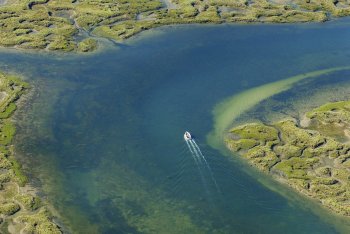
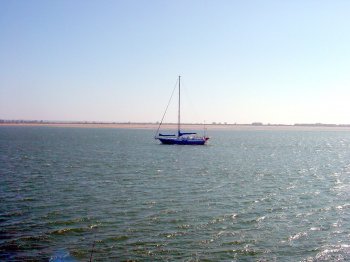
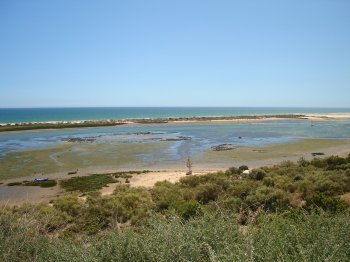
From Ancão (east of Faro) to Manta Rota Beach, the Ria Formosa presents itself as a unique configuration that gives the Algarve's leeward coast a special color. The 60 km that make up the Ria Formosa Natural Park are composed of semi-still waters, mudflats, mangroves, salt pans, channels, and five islets. Barreta, Culatra, Armona, Tavira, and Cabanas are the names of these constantly transforming sandy formations, which, separating the land from the sea, create an extremely rich natural barrier in terms of flora and fauna. It has been classified as one of the Seven Natural Wonders of Portugal.
Ideal for sport fishing enthusiasts, the mouth of the Guadiana River offers excellent views of the neighboring country. In Castro Marim, with the widening of the riverbed, the area classified as a Nature Reserve is dominated by salt marshes and former rice paddies. The Guadiana River runs for 830 km and is navigable for the last 48 km, where its width varies between 100 and 500 meters.
This Natural Park is characterised by the existence of a cordon of dunes and beaches that protects a lagoon area, whose average depth is 2 metres. Part of this is permanently submerged, while another part emerges during low tide. The surface of the Park extends from the Ancão Beach to Manta Rota and includes wide variety of habitats, including barrier islands, salt marshes, sand bars and vasa, dunes, salt marshes, freshwater and brackish ponds, waterways, forests and agricultural areas, which refers to a wide variety of flora and fauna.