Explore the best places
Results for PROBLEMGO.com how to get out of jail without bail money in Portugal


M'AR De AR Muralhas
- hotels
Travessa da Palmeira, 4-6
7000-546, Évora
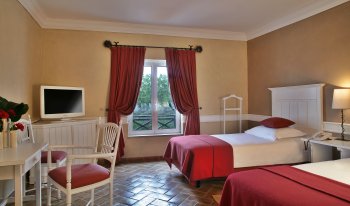
M’Ar De AR Muralhas – Timeless Charm Hotel is the new name of the famous Hotel da Cartuxa, opened in 1997, and which was now completely renovated. The hotel keeps its 4 star classification and is located in the historic center of the city of Évora, right in the heart of the area classified by UNESCO as World Heritage. In this hotel, quality is the synonym of welcome and friendship, where guests feel the comfort of the best hotels in the world, without looking like any of them. This surprising hotel offers an inviting swimming pool overlooking the city wall, …
Povoado de Soutelo
- heritage
Gralhas
5470-160, Gralhas
Castro located between Solveira, Santo André and crows at the end of the Stream of the field, about 900 meters above sea level. On the coasts of castro, on the West side and in a vast area, there are several concentrations of stone from collapses of structures, well-defined walls alignments and numerous ceramic fragments of Roman typology. Despite all these traces are hidden by dense vegetation, it is clear the existence of this important village, where there was no lack of including the space for the dead. Identify at least three graves excavated in the rocky outcrop, without anthropomorphic format. …

Silvares
- country
- heritage
Silvares
6230, Fundão
Silvares is on of the oldest villages in the parish and its houses are placed around the mother church, on the banks of the Zêzere river. It stands out for its narrow streets with old houses and features the following monuments: chapels of Saint Sebastião, Espírito Santo, Saint Eufémia and Saint Luzia, the crucifix, the fountains and th roman fountains. The crafts work includes drums, flutes, adufes (a kind of a tambourine), iron objects, regional embroideries and more.

Jardim Afonso de Albuquerque
- country
- leisure
Praça Afonso de Albuquerque
1400, Lisboa
The square has strong connections with the Discoveries, this was the former sand-pit where the Real cais de Belém used to anchor. Now it is a gardened area, sided by quickset hedges and trees (nettle-tree and stone pine), lake and sculptures, with the Afonso de Albuquerque, vice-king of India, statue, manueline style, standing out. This garden presents also four statues created by Barata Feio, placed at the square corners.

Convento da Conceição / Museu Rainha Dona Leonor
- heritage
Largo da Conceição, 5
7800-131, Beja
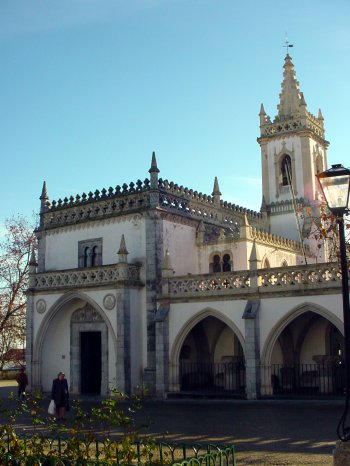
Church of the former Franciscan Convent of Santa Clara, founded in the 15th century. At the end of the 19th and beginning of the 20th centuries, the city of Beja suffered extensive destruction of its heritage, and only the church, the cloister, the chapter house, and adjacent rooms survived from this former convent. The Gothic portal on the facade stands out, and inside, the gilded woodcarving and tilework are noteworthy. The Queen Dona Leonor Museum is now located within the convent.
Convento dos Capuchos
- heritage
Rua Miradouro dos Capuchos
2825, Caparica
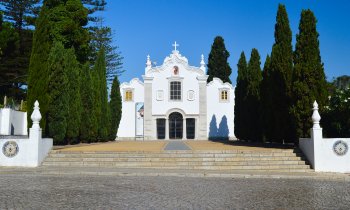
Convent built by D. Lourenço Pires de Távora in 1558. It has a façade surrounded by corners topped off in the acroteria by flames and an interior porch with three arches. The large window of the choir is topped by a niche with a clay sculpture. In the galilee, tile panels stand out. Located in the area of the Protected Landscape of Arriba Fóssil da Costa de Caparica, from there you can contemplate the landscape of the coast of Lisbon, Estoril and Cascais.
Convento e Igreja de São Francisco
- heritage
Rua de São Francisco, 59
5300-037, Bragança
Built in the 13th century to house the mendicant order of San Francisco, it underwent several renovations in the following centuries, with the Mannerist façade dating back to 1635. In the second half of the 19th century, in the convent area, it was built the Military Hospital and, later, the Duke of Bragança Asylum. Among the various 18th century altarpieces it has, the one in the Chapel of Nossa Senhora da Conceição stands out, in which some rocaille applications are notorious.
Basílica de Nossa Senhora do Rosário de Fátima
- heritage
Cova de Iria
2495, Fátima
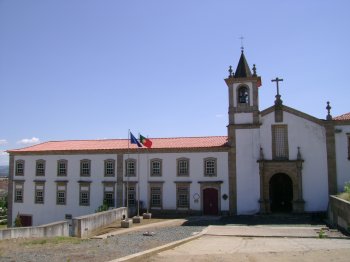
Temple of neo-baroque structure, built in the early 20th century, on the site of the apparitions of our Lady. Dominated by a central tower of several floors, the colonnade is decorated by ceramic panels representing the Via Crucis. Designed by the Dutch architect Gerard van Kriechen and continued by the architect João Antunes, stands out for its dimensions, the statue of the Immaculate Heart of Mary in the niche of the tower and the mosaic that represents the Holy Trinity crowning of our Lady.
Capela da Misericórdia de Álvaro
- heritage
Praça de Misericórdia
6160-011, Oleiros
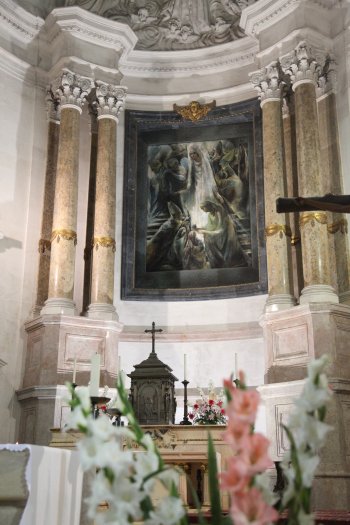
Religious architecture consisting of nave and chancel, separated by a Transept. The interior retains some of the symbolic religious figures, like a dead Christ with the Holy Women and s. John the Evangelist. It stands out, too, the altar in gilded, coffered ceiling and the niches of the main Chapel, where you can see 2 figures carved in stone from Ançã, depicting Joseph of Arimathea and Nicodemus. The ceiling panels saves the Via Crucis.
Capela das Almas / Capela de Santa Catarina
- heritage
Rua de Santa Catarina, 426-428
4000-124, Porto
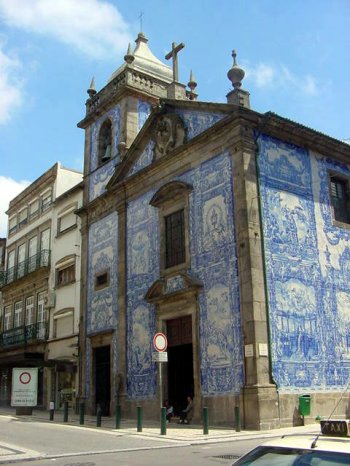
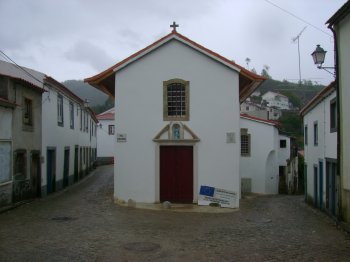
With a great architectonical simplicity, the Almas chapel dates from the beginning of the XVIII, and was repaired and enlarged in 1801. In 1929, the façades were covered with azulejos, by Eduardo Leite, representing the life of São Francisco de Assis and of Santa Catarina. The main façade presents a glass window by the painter Amândio Silva. Inside, the panel painted by Joaquim Rafael, representing the Lord’s Ascension and the image of Nossa Senhora das Almas stand out.