Explore the best places
Results for PROBLEMGO.com pay bond online get out today St. Gallen in Portugal


Igreja Paroquial de Codessoso
- heritage
Rua da Igreja
5460-370, Codessoso
Codessoso parish church, dedicated to St. Lawrence, has longitudinal-oriented plant east-northeast (ENE)\/WSW at 10-Southwest (OSO), most notably in his volume the chancel, which has annexed the sacristy, and the body of the Church whose main facade, simple, with a rectangular façade has a porch supported by two columns and decorated dogs. The Bell Tower is located away from the Church, docked that limits the churchyard, has two tears, ringers and flanked by triangular spires topped ball and finished off with a cross in the middle. Inside the Church include the high altar, which occupies the entire wall of the headboard, …

Passeio pelo Castelo dos Templários
- heritage
Castelo Branco
6000, Castelo Branco
Strong and striking presence, the Templáriso Castle is an emblematic place of the city. Located in a high place, it is worthy of visit, not only for its history but also for the panoramic view it offers, as beautiful as wide. From the primitive castle that dominated the city long ago, there’s not much left today due to continuous works. Built between 1214 and 1230 by the Templar it enclosed a circle of walls and towers. Here you may also visit the Santa Maria do Castelo Church. In its churchyard gathered the Assembly of good-men and the monastic and military …
Praça da Liberdade
- heritage
Praça da Liberdade
4000-322, Porto
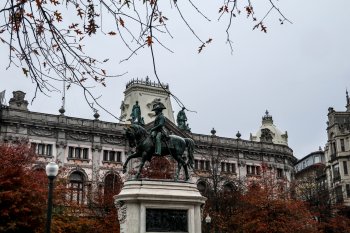
The Praça da Liberdade has known several names along the centuries. Its construction was due to the progressive growing of the city. It was a meeting point for politicians, writers and artists and became a place searched for all classes. Among other marking events there will always be the death by hanging of the liberals, in 1829, (after this rehabilitated as “liberty martyrs”. In 1866 is open the monument to the liberal King, a tribute of the city to D. Pedro IV. The Portuguese Republic was first proclaimed here, January, 31st, 1891. In 1916, when the city council decided to …
Alvito da Beira
- country
- heritage
Alvito da Beira
6150, Proença-a-Nova
The village of Alvito da Beira is believed to be of Moorish origin. According to historians, it was the Arabs who introduced the first olive groves to the region. These reached such a size that by the early 20th century, there were 10 olive presses in the parish. Small walls were built to protect the olive trees, of which traces still remain. In terms of architectural heritage, the main church, cross, old fountain, Mó fountain, Dáspera fountain, and Sobrainho fountain stand out. Crafts include weaving, tinsmithing, hand-made shoemaking, and blacksmithing.
Casal do Rei
- country
- heritage
Casal do Rei
6285-061, Vide
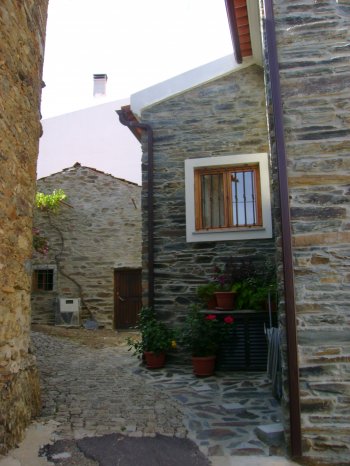
Casal do Rei, a village of 150 inhabitants, mostly farmers and resin extractors, is located at 6 km away from Vide. Its architectural heritage includes the chapel that evokes Saint Joseph. The legend says that Domingos de Fugueiredo, a friar that escaped his convent, found refuge in this village and oredered the building of the chapel. This village stands out for its schist houses and for its communal ways of life (including the olive oil press, the oven and the mill). Nearby, there is a wood with vestiges of primitive vegetation.
Joanes
- country
- heritage
Aldeia de Joanes
6230-045, Fundão
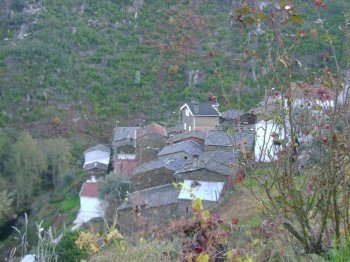
Located on a counterfort of the Gardunha mountain, between the valley and the foothill, this is one of the oldest villages in the parish. The romanesque church with ulterior details, the chapels of the Holy Spirit, Saint Pelágio, Our Lady of Conceição, Our Lady of Amparo, Saint Tiago, Saint Sebastian and Saint Catarina, the House of Saint peter, the custody, the 16th century houses and the fountains of Figueiredo and of the Rua da Fonte (Fountain Street) stand out. Nearby, there are the ruins of the Convent of the Seixo of the Capuchos Friars, of the early 16th century. The …

São Vicente da Beira
- country
- heritage
São Vicente da Beira
6005, São Vicente da Beira
It was one of the first villages with register, dated from 1195. Located at the foot of the southerly ladder of Gardunha Sierra, it stands out for its architectonical patrimony: the Town house, pillory, mother-church (where is the reliquary of S. Vicente), Misericórdia church (with the sacra art museum), chapels of Santo António, S. Sebastião and S. Francisco and Nossa Senhora da Orada, Calvary, emblazoned houses, fountain, Town hall and Misericórdia Hospital. The strawy chairs, the patchwork-quilts, the linen towels and wood works are some examples of the local handicraft.
Golden Tram 242 Lisbonne Hostel
- hotels
Rua Áurea, 242
1100-065, Lisboa
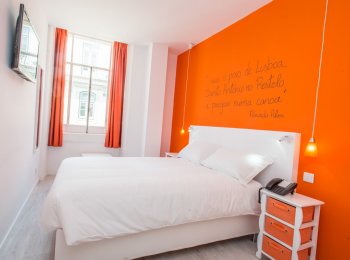
The Goldem Tram 242, located in baixa pombalina, in the Centre of Lisbon, has 131 beds, distributed over 20 rooms, 16 of them are bedrooms, (mixed, male and female) with bunks and black out curtains, and four are suites with a private bathroom. The first floor of the hostel has a café and a lounge bar where every morning is served breakfast. The Coffee Shop – Tram Lounge Bar also proposes meals based on Portuguese tapas specialties and assorted snacks. The values described as single room are applied per bed in the dorms.
Ecork Hotel Évora
- hotels
Quinta da Deserta e Malina
7000-804, Évora
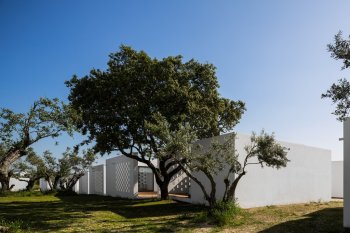
The Ecorkhotel, Evora Suites & SPA, in Évora, uses Cork and the ecology as hallmarks. Surrounded by the tranquility of Alentejo, this eco-resort spreads over 8 thousand square meters in a unique and welcoming environment among cork oaks, holm oaks and olive trees. Inside and out, the building establishes a strong relationship with Cork. In partnership with Amorim Cork, the outside of the hotel is covered with this material, something unprecedented in Portugal and little seen in the world. Inside, there are 56 private suites with 70 m 2 equipped with everything you need for maximum comfort.
Cemitério Lusitano-romano / Quinta da Relva
- heritage
EN323 - Quinta da Relva
5060, Provesende
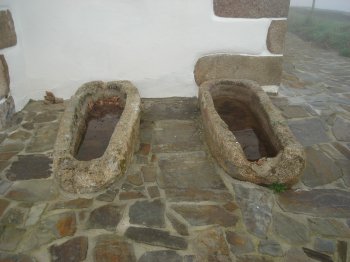
Roman and medieval necropolis, consisting of four graves of different types and chronology. Some graves are structured with vertical slate slabs, others in the shape of a box, and still others as anthropomorphic sarcophagi. The excavations carried out at the site allowed the removal of some remains consisting of ceramic artefacts, in addition to an anthropomorphic stele, currently on display in the Abade de Baçal Museum garden, in Bragança. However, of all the tombs discovered, only two anthropomorphic sarcophagi remain, leaning against the elevation on the Epistle side of the Sanctuary of Santa Marinha.