Explore the best places
Results for access main PROBLEMGO.COM buy a fake letter from the IRS saying I owe nothing in Portugal


Casa das Figuras
- heritage
Avenida José Maria Nunes
8000-145, Faro
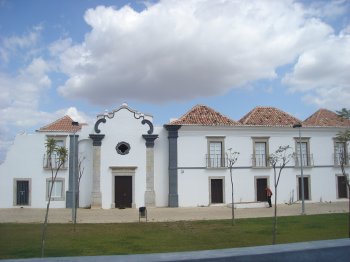
This 17th century building has a main façade which is classified that presents an indented gable with two winged dragons that have human faces, sided by two dolphins and, in the centre, a head of a black warrior with decorations. On the foundations, one can see inscriptions that indicate the aesthetic and decorative influences from Brazil.
Capela do Salvador do Mundo / Capela de São Salvador do Mundo
- heritage
Estrada da Circunvalação
7320, Santiago Maior
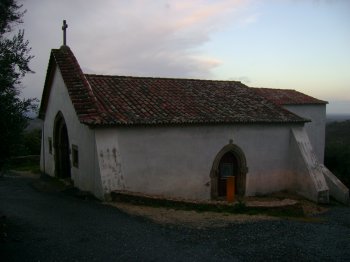
A church of Gothic, proto-Baroque, and Baroque architecture, with an attached sacristy, a single nave, and a chancel covered in white and blue tiles dating from 1695 that extend to the triumphal arch. The main altarpiece dates back to the 17th century. It is notable for its antiquity and for being the first Christian religious building in town.
Fundação Arpad Szenes - Vieira da Silva
- art
Praça das Amoreiras, 56
1250-020, Lisboa
Placed at the former Real Fábrica dos Tecidos de Seda, in a building from the XVIII century, remodelled and adapted to shelter a museum and a documentation and investigation centre, the foundation, opened in November 1994, has as main purpose the divulging and study the works of the painters Arpad Szenes e Vieira da Silva.
Igreja de São Tiago
- heritage
Praça do Comércio, 57
3000-116, Coimbra
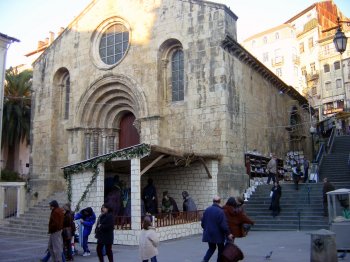
Romanic church from the last quarter of the XII century. The temple, with three naves, was sacred in 1206. It suffered transformations on the XVI, XVIII and XIX centuries. Outside the eye-window and the portal with columns and decorated capitals stand out. Inside are worthy of notice the retable at the main-chapel and the gothic portico of the chapel.
Igreja de Nossa Senhora da Conceição
- heritage
Rossio da Vila de Monforte
7450, Monforte
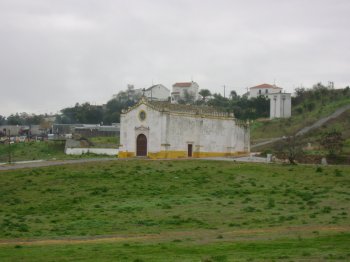
Church with buttresses topped by pinnacles and the entire top is battlemented. On the main façade, the portico, topped by an oculus, has a round arch, supported on pilasters and with a triangular pediment. Inside it has a single nave, covered by a barrel vault, decorated with tempera paintings. The walls are covered with "standard" tiles from the 17th century.
Igreja Paroquial de Santa Marinha
- heritage
Largo Santa Marinha
4400-012, Vila Nova de Gaia
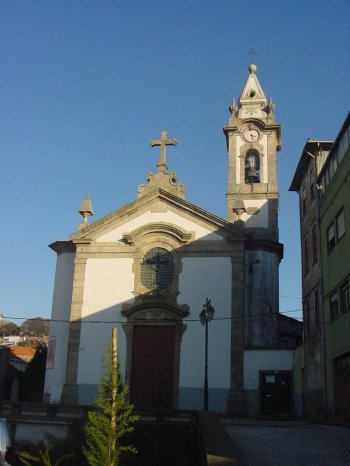
This is a church from the 1500s that was completely rebuilt during the 18th century. Planned by Nasoni, it features a sober construction with the portal ended by an outstanding arch. The façade is sided by a bell tower. The south tower has a belfry that was added on the second half of the 19th century. Worthy of notice are the lateral doors of the main chapel.
Palácio e Quinta do Ramalhão / Paço Real do Ramalhão
- heritage
EN249
2710, São Pedro de Sintra
Inside the building, it is worthy to mention the Main Room, the dining room from the ends of the 18th century and painted in frescoes by Pillement. The Queen D. Carlota Joaquina was incarcerated here after refusing to swear loyalty to the 1822 Constitution. Presently it has the São José College belonging to the Portuguese Dominican Sisters.
Ermida de São Luís / Igreja Matriz de Ourique
- heritage
Rua António Vitorino de Matos, 1
7670-363, Ourique
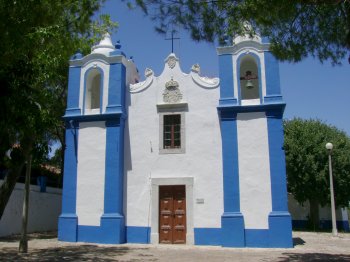
Small pilgrimage hermitage with beautiful Pombaline tile panels. Rebuilt in the 18th century at the behest of King João V. The elegance of its main façade stands out, with rococo mortar work. Inside, the Baroque is already fully established in the large gilded and polychrome structures that spill over from the altarpieces.
Casa e Portal de Simães
- heritage
Lugar de Simães
4610, Moure
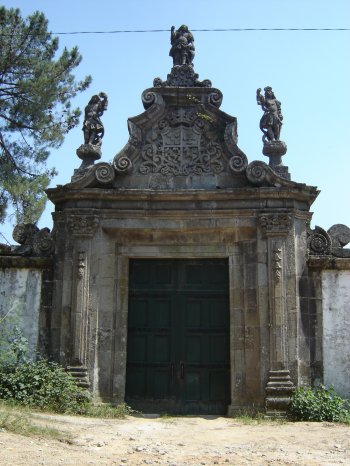
The set comprehends the elements that characterize the main pateo, the gardens, the armoured gate, the fountains, the statues and the main wall. The sculptures date back to the 18th century. On the wall that faces the houses there are five fountains devoted to the five continents.
Capela de Santo António da Neve
- heritage
Coentral
3280, Coentral
This temple was constructed in 1782 and it has dome coverage in stone. The plant is longitudinal and it is composed by rectangular nave and main chapel. On the main façade there is a door with a pediment centred by two windows and topped by a round opening with framed span.