Dolmen of polygonal Chamber with six Struts, corridor and cover slab, shifted. Belong to the set named "Antas de Belas". Is classified as a national monument.
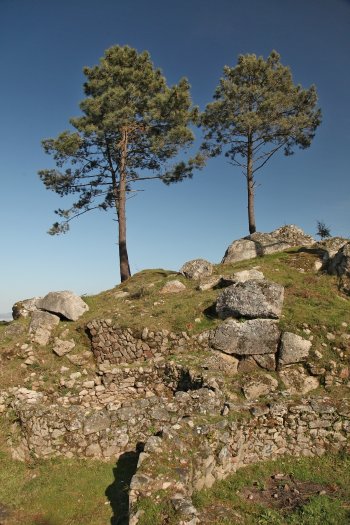
This fortified village occupies a hilltop, around which we can see a piece of the wall with ellipsoidal shape, rather damaged. It is also possible to spot some blocks that used to be door posts. In the enclosure it is possible to find some small loose blocks.
Fortified settlement proto-history. Has a line of wall showing the inner face faceadas not stones and pits excavated in the outcrop. There is evidence of a family housing nucleus of circular plant constructions. Are classified as Property in the public interest.
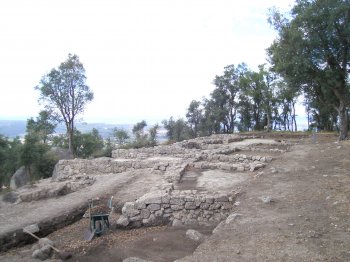
Protohistoric fortified settlement with circular buildings, surrounded by three orders of walls, and revealing traces of occupation in Roman and medieval times. Two large buildings stand out that occupy the central area of the station's upper platform, one of which is composed of a Domus with a quadrangular plan, with a central atrium and some compartments around it, and the other with a rectangular plan.
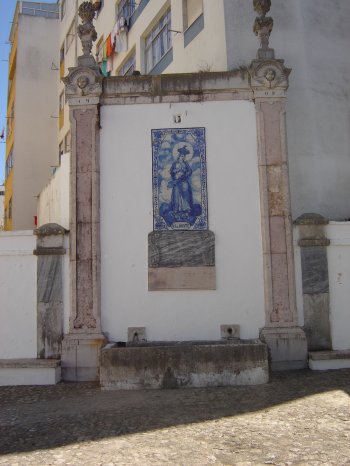
A fountain that dates back to 1772. In the centre there is a monochrome tile panel of the 19th century with an image of Our Lady of the Hill. In the lateral walls there are four marble stones, copies of the roman originals that were brought from the Miróbriga diggings by Frei Manuel do Cenáculo.