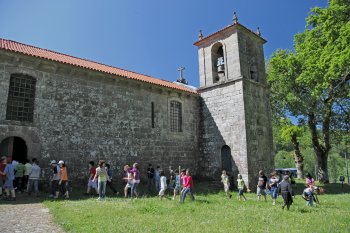
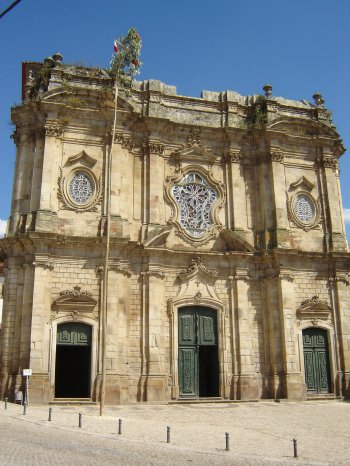
The church remains from the monastic complex, which retains interesting architectural features. On the front, the portal with four archivolts is the primitive one and in the upper area, redone in the 17th century, São Bernardo, the founder of Cistercian, the Lady of the Assunção and São Bento, surmounted by the coat of arms of the Order, keep us company in this place isolated but superb. The head of the temple is divided into quadrangular chapels, revealing the typically Cistercian architecture. The interior, with 3 naves, without a transept, was greatly transformed in the modern era. In the monastic dependencies …
In its time, it was one of the largest Cistercian monasteries in Portugal, the grantee of vast lands around it, with the obligation to cultivate and populate them. Its construction began in 1155, shortly after the donation of the land made to the Order by Egas Moniz, assistant to D. Afonso Henriques, and his wife Teresa Afonso. It was consecrated in 1255, when the monastic complex was complete. The church, of large dimensions, stands out, imposing, in the middle of the uniform houses of the small village that was formed to the east. Between the centuries. In the 16th and …